Thursday, 17 November 2016

Hunger Games Swede

As our swede project we decided to reenact, on a very low budget, and within a week, The Hunger Games. We decided on this film as the vast majority of the film is within 'The Arena' that we thought could successfully be represented by Ilkley Moor, a 15 minute walk from school. It would also be a fun swede to do as it contains lots of action and excentric characters. My role in the swede was the character 'Rue' who dies within The Arena, I also filmed parts of the swede as we rotated the role of camera operator.

Preproduction 

- First we made a list of what we thought, as a group, were the key scenes/moments in the film.
- Then we discussed and assigned roles within the group.
- We also had to make a table which contained the scene, who was needed, the props, and when and       where we would film it
- Finally we made props from cardboard, string, and sticks, and found wigs to use whilst filming.


Editing

To Edit the swede together, I used the application of 'Final Cut Pro'. We imported our preferred takes and edited them together, using transitions where necessary. I adjusted the volume of some of clips and also had to use the 'blade' tool cut out sounds of the camera moving and people talking. We initially had quite a calm hunger games theme tune over the swede, however deciding that it wasn't appropriate for the whole video, we added a more tense theme tune to the middle of the swede. Finally, when we were happy with how it looked, I added a title of 'The Hunger Games Swede' just prior to the last shot. Then finally the credits followed by the mocking jay whistle, the final sound on a black screen to bring together the end of the swede.

Challenges

We found, as a group of 9, it was very difficult to get everyone at the location, at the correct time. It was also hard to keep in contact with anyone who was arriving early/late. Another very obvious challenge was the timing of which we were given to complete filming and editing of the swede - one and a bit weeks. Due to this many of the filming was rushed, and some points we had discussed earlier to include in the swede were missed out.

Technical Analysis


Thursday, 10 November 2016

Assessment of current attainment and predicted grade

Overall I feel you have made a very positive start to the course. Your written work is very good and I am impressed by your commitment, enthusiasm and desire to do well. You are currently working at a high Proficient level (A/B); in order to ensure your work falls comfortably within your targeted A grade, you should do the following going forward:
Get your work up to date; Your 5th Film Opening should by now be on your blog; please complete this by the end of this week.
Your analyses need to make better use of semiotics. This means describing denotation and connotation. In other words what is shown and what is implied. You understand these concepts but don’t refer to them correctly. See me if you are unsure.
Now that we are approaching production, I would recommend that you start blogging more regularly on everything that you are doing on the course. This could start with your swede; write a blog (or do a vlog) on your contribution to the production and what your challenges/difficulties were in achieving your swede.

Mr VZ

Friday, 14 October 2016

Feedback 12th October 2016


After listening to my feedback I have ensured that:
- All of my terminology is highlighted in pink
- I have rethought the analysis of 'Coraline' (as it would have been very time consuming)
- I have completed the film analyses, using a variety of multi media.

Friday, 30 September 2016

Previous Year 12 Film Opening Analysis

Analysis of film opening: The Brief 

film opening begins with a blurred in shot for the title scene of cars passing by on a road, these titles inform us who the film opening was produced, directed and edited by. It then switches to a shot of a boy walking into the gym in the bottom right hand corner there are the time and place being typed up in a typewriter font and and a typewriter noise. This could relate to a spy film as it is something that is commonly seen in these sort of movies as the boy walks along the corridor and up the stairs there are a range of different shots used such as a tracking shot. There is also a steady beat of music building up as he walks towards the gym door. 


When he walks through the doors of the gym there is a blurred in low angle shot showing just his body and not his face using a range of different shots gives the film opening a better effect and makes it more interesting. once he is in the gym the beat of the music gets louder and faster. The camera shows a close up of the boy putting his shoes on as it shows the viewer what he is here to do. it then shows an extreme close up of the back of the boys head just before he starts running this shot has a central composition because he runs in a straight line.


While the subjects is running around the gym the camera follows him at this point the camera is hand held making the viewer seem more involved in the film. This film opening uses central composition a lot this draws your eyes towards the subjects and works very well in which the way they have used it. The message shown by the close up of the phone informs the reader what is going on it also uses a shallow depth of field meaning your eyes just focus on the text.


The scene the switches to a tracking shot of the subject walking along a path the typewriter text is used again to give the viewer an idea of where he is. We see a full body shot of the boy and another boy is seen behind him it looks like he is following him because he is looking at him. When he sees the boy he starts running and music picks up, the music is tense and really fast. The camera is hand held this resembles to them running and makes you feel like you are part of the action.


The camera shows a point of view shot showing the boys point of view when he is running the also makes the viewer feel like they are in the action. It also shows flashbacks of when he was in the gym and how the things in the gym helped him in real life for example when he jumps over the wall it shows him doing pull-ups in the gym.


When the boy who is chasing the other boy get passed his bag it shows you a close up shot of his face as if you are inside the bag looking at him when the boy gets away we see an over the shoulder shot of him walking slowly across a bridge. If i was to grade this work i would give it an A as a wide range of shots have been used and loads of different filming techniques have been used the opening is also easy to understand and invites the viewer in making then want to watch on.

Thursday, 29 September 2016

The Revenant Film Opening Analysis


Charlie and the Chocolate Factory Film Opening Analysis

Charlie and the Chocolate Factory
Director: Tim Burton
Year: 2005
Production Co: Warner Bros. Village    Roadshow Pictures    Plan B Entertainment
Distributor: Warner Bros    FilmFlex
Budget: $150 million
Box Office: $475 million

This imaginative and comedic 2005 film is based on the popular Roald Dahl tale of a young boy named Charlie Bucket. His fortunes change when he wins a ticket for a tour around the most magnificent chocolate factory in the world, and during, meets the most unusual chocolate maker. I will now analyse the films opening and the impression it gives onto the rest of the film.


Film Productions


Warner Bros. Ident : 6 seconds


Village Roadshow Pictures : 6 seconds


Unlike many films, where the company idents are put in before the opening of the film starts, these idents are integrated within the start of the film, followed by the titles (which I will analyse later). I chose to mention this and I think that putting the idents, fading in and out between the snow and sky at the beginning of the opening, brings the audience immediately into the mysterious setting in which the director wishes to portray.


Opening shots


The first shot that the viewers see contain, what we guess is, the chimneys of the chocolate factory. It is a long shot that travels through the snow and the clouds, until it discovers the chimneys; this is effective as it continues with the same environment and establishing shot that the company idents appear in. The tall chimneys, that climb into the air from what we assume is a large, industrialised factory contrast marginally with the birds eye shot that we see right at the end of the film opening which shows that this extravagant factory is surrounded by small terrace houses, showing connotations of the poverty that surrounds the factory.


The camera then, in the same continuous shot, zooms closer into the central chimney before climbing to the top where it enters. This shot is effective as it makes the reader feel like they are part of the journey, and they are about to enter the factory and witness what the characters will witness later in the film.


Titles


This film, like many others, uses its opening title sequence to reel the audience in at the beginning of the film. This style of titles is called 'hook'. As well as the words being in a simple, clear font - supporting the target audience of younger people watching the film, the titles compliment the film very well. The colour choice of the text, is golden, giving representations of the golden ticket and the exciting, rare opportunity that will be given in the film to witness the inside of the factory, just as the viewers are witnessing first.

The titles in the opening follow the journey of the chocolate being made in the factory, being packaged up and finally but in vans to be distributed to shops. This is an effective way of incorporating the titles, as instead of titles on a blank, uninteresting screen, failing to grab the viewers attention, the viewers experience an insight into the factory, the making of the chocolate, and the golden tickets, before anyone else. They even have a glimpse of a mysterious, unknown hand, that we guess is the usual character 'Willy Wonka'. This is a use of narrative enigma to reel the audience in and start to tell a story.


Tuesday, 27 September 2016

Submarine Film Opening Analysis

Submarine
Richard Ayoade
Year: 2010
Production Co: Warp Films
Distributror: Optimum
Budget: $1.5m
Box Office: $3.8m


This film is a Coming-of-age comedy-drama, based and adapted from the book 'Submarine' by Joe Dunthorne. It was written and directed by Richard Ayoade, which was his directional debut. Its main character 'Oliver Tate' is played by Craig Roberts. The films budget was $1.5 million. I will be analysing the 1 minute 52 second Film opening, under 4 main technical areas; Cinematography, Editing, Sound and Mise-en-scence. I will also start by looking at the film companies involved in this film's production and their idents which appear at the beginning of the opening.


Film Productions


Film 4 - 9 seconds
UK Film Council - 8 seconds


Cinematography

Opening Shots

             
The first shot that we see, as an audience, is a pan of a bedroom, to which we suspect belongs to the main character, a young boy named Oliver. This is a very effective way of opening the movie because, as an audience, we are immediately making our first impressions of the character from the mise-en-scène of the bedroom, with many props being representations of characteristics. In these few screenshots from the pan, a specific few objects stand out to me. 

The first is the skeleton that can be seen in the 2nd screenshot, which gives the assumption that this character is interested in subjects that would usually not be the norm for a young boy, which leads me to the object next to it, a telescope. Giving a clever representation of the boy being an outsider, looking in whilst he seems to like to spend much of his time in his room with his many possessions.


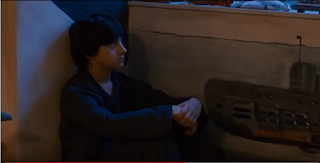
As the pan comes to an end, we spot in the bottom right corner, a character sat on the floor. The high angle shot, looking down onto the character, shows that the boy is not wanting to be seen, 
and enjoys his own company without being disturbed. There are then two short shots that, in each, come closer to the boys face, which seem to 'disturb' him as his head turns and he looks into the camera giving direct mode of addressBraking the separation  between actor and character, continuing with the idea of a different and quirky character.


After this shot, a sense of mystery is given, as the boy and the bedroom shots finish and establishing shots of the Welsh landscape and coastline replace them...


Titles

There are 5 different titles that appear in the same font and colours, with varied gaps, filled with the shots of the bedroom. They have a blue background, with white letters, noting the different companies involved with the film. The titles seem to match the impression of the character that we get from the bedroom shots; the font is bold and the words are disjointed, just as 'Oliver' seems to be from everyone else. Because both the bedroom and the tittles bring across the same thing, they work well intertwining with one another. The blue colour also supports this representation with it having cold connotations.


The uniformity of the titles then changes on the last title shot where the name of the film is shown. Although the disjointed, quirky font is continued onto this title with the 3 way separation of the work 'Submarine' the royal blue background that was on the previous 5 title shots, has been replaced with one of the establishing shots, shown for the past 20 seconds of the opening. 


Sounds

At the beginning of this film opening, 36 seconds in, we hear sound effects of the sea and the birds quietly coming through. This sound had connotations with relaxation, blocking out any distractions from other people; it is plainly just nature. This adds weight to the idea of the boys characteristics being independent and enjoying his own company. At 52 seconds, when we catch a glimpse of the boy for the first time the audience experiences narrative enigma from dialect which we assume is the voice of the protagonist, the boy that we can see. At 1.06 minutes, the establishing shots start, and with them play a song that has a melencoly feel, that matches the colours and the scenes that continue to the end of the opening.